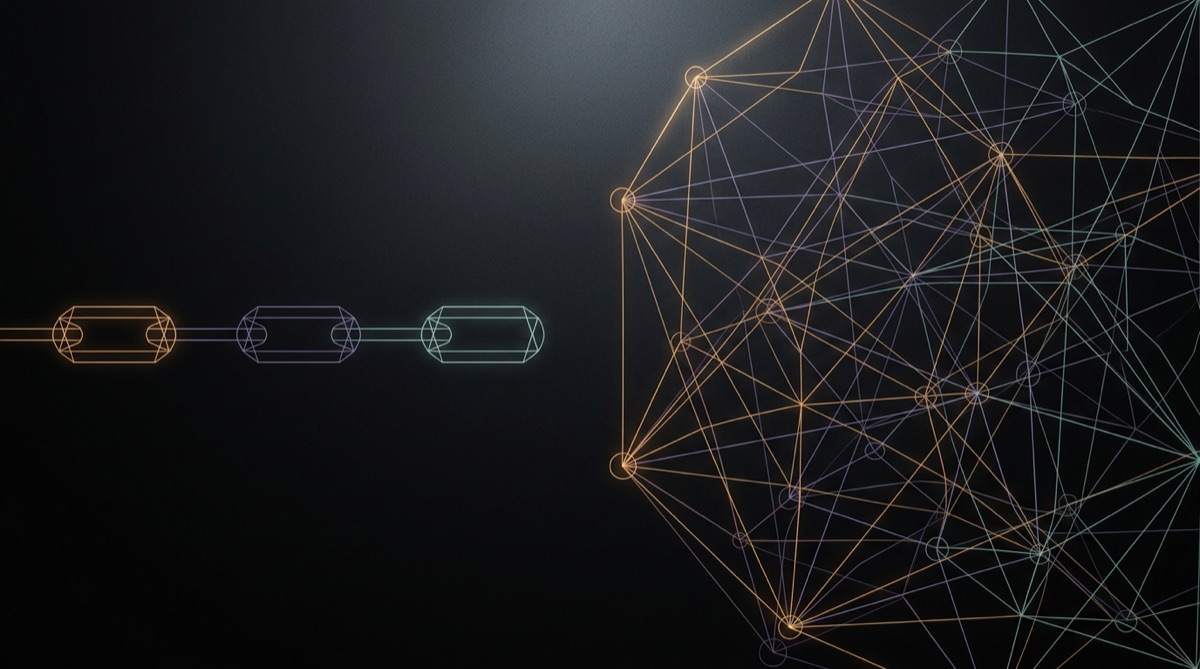
Key Takeaways
- Standard RAG retrieves text chunks by semantic similarity from a vector database, while GraphRAG first builds a knowledge graph of entities and relationships to answer multi-hop questions.
- Microsoft Research released GraphRAG as open source in mid-2024, and it queries in two modes: local search across entity relationships and global search across community summaries.
- GraphRAG costs more and indexes slower because a language model must extract the graph first, and it is more complex to deploy and maintain than standard RAG.
- Standard RAG remains the right default for most enterprise knowledge retrieval, backed by a mature ecosystem including LangChain, LlamaIndex, Pinecone, Weaviate and pgvector.
- Choose GraphRAG when queries require synthesising across many documents or reasoning over entity relationships; otherwise a hybrid router combining both is an increasingly common production pattern.
Retrieval-augmented generation — RAG — has become the default architecture for enterprise AI applications that need to work with private or proprietary knowledge. Rather than relying solely on a model's training data, RAG retrieves relevant documents at query time and passes them to the model as context. The results are more accurate, more current and more trustworthy than pure generation.
But RAG has limits, and Microsoft's GraphRAG — released as open source in 2024 and now widely adopted — was designed to address them.
This post explains both architectures clearly, compares them honestly, and helps you decide which is right for your use case.
What is RAG?
Standard RAG works in two stages.
First, at indexing time, your documents are chunked into segments and passed through an embedding model. The resulting vectors are stored in a vector database — Pinecone, Weaviate and pgvector are commonly used.
At query time, the user's question is embedded using the same model, and the database returns the most semantically similar chunks. Those chunks are injected into the prompt as context, and the language model generates an answer grounded in the retrieved material.
It is elegant, fast and well-understood. RAG fits most enterprise knowledge retrieval problems, and it is relatively straightforward to build.
Strengths
- Fast to implement and iterate on
- Works well for document search and question-answering over large corpora
- Scales well with document volume
- Retrieval quality is easy to evaluate and improve
- Wide ecosystem of tools, frameworks (LangChain, LlamaIndex) and managed services
Weaknesses
- Retrieves chunks, not concepts — misses connections between pieces of information spread across multiple documents
- Poor at answering questions that require synthesising information from many sources simultaneously
- Loses structural and relational context between entities
- "Needle in a haystack" retrieval depends heavily on the quality of the query embedding
What is GraphRAG?
GraphRAG, developed by Microsoft Research and released as an open-source project in mid-2024, takes a fundamentally different approach. Rather than chunking documents and embedding them directly, it first extracts a knowledge graph from the source corpus.
During indexing, a language model reads through your documents and extracts entities — people, organisations, concepts, events — and the relationships between them. These are stored as a graph of nodes and edges, alongside community summaries describing clusters of related entities.
At query time, GraphRAG can operate in two modes:
- Local search — traverses the graph from entities relevant to the query, pulling in their relationships and associated source text
- Global search — generates answers by reasoning over the community summaries, enabling queries that require synthesising information across the entire corpus
Strengths
- Excels at complex, multi-hop questions that require connecting information across documents
- Preserves relationships and context that vector search discards
- Global search enables genuine corpus-wide synthesis — "What are the main themes across all our research?" becomes answerable
- Reduces hallucination on relational queries
Weaknesses
- Significantly more expensive to index — LLM calls required to extract the graph
- Indexing is slower — not suitable for rapidly changing document sets without incremental graph updates
- More complex to deploy and maintain
- Overkill for simple question-answering use cases
- Graph quality depends on the accuracy of the extraction model
Head-to-Head Summary
| Standard RAG | GraphRAG | |
|---|---|---|
| Best for | Document Q&A, search | Complex reasoning, synthesis |
| Indexing cost | Low | High |
| Query speed | Fast | Slower (global search) |
| Multi-hop queries | Weak | Strong |
| Corpus-wide synthesis | Poor | Excellent |
| Setup complexity | Low–Medium | Medium–High |
| Ecosystem maturity | Very mature | Maturing rapidly |
Which Should You Choose?
Choose standard RAG if: your users need to find specific information within documents, or your document set changes frequently. It is also the right choice if you are building a knowledge base, internal search tool or document Q&A system. RAG is the right default for the majority of enterprise knowledge retrieval problems.
Choose GraphRAG if: your use case requires reasoning across many documents simultaneously, or users ask questions like "what is the relationship between X and Y?" or "summarise the key themes across our research". It also fits when you are working with a relatively stable corpus — technical documentation, research archives, regulatory libraries.
Consider a hybrid approach if: your application needs both fast local retrieval and deeper synthesis. This is increasingly the production pattern: GraphRAG handles complex analytical queries, standard RAG handles specific document lookups, and a router decides which path to use at query time.
The Practical Reality
GraphRAG upgrades standard RAG for a specific class of problem rather than replacing it. Most enterprise applications start with standard RAG and only hit its limits when users begin asking questions that connect information across many documents.
The signal to watch for is users rephrasing the same question multiple times, or adding qualifiers like "based on everything you know". That usually means the retrieval architecture is not giving the model what it needs to answer well.
When you hit that ceiling, GraphRAG is worth the additional complexity.
Frequently asked questions
What is the difference between RAG and GraphRAG?
Standard RAG retrieves text chunks by semantic similarity from a vector database and passes them to the model. GraphRAG first extracts a knowledge graph of entities and relationships from the corpus, which lets it answer multi-hop and corpus-wide questions that chunk retrieval misses.
When should you use standard RAG?
For most enterprise knowledge retrieval — document search and question-answering over large corpora. It is fast to build, scales well with volume, easy to evaluate, and supported by a wide ecosystem including LangChain, LlamaIndex and vector databases such as Pinecone, Weaviate and pgvector.
When is GraphRAG worth the extra cost?
When queries require synthesising information across many documents or reasoning over relationships between entities. GraphRAG reduces hallucination on relational queries, but it is more expensive and slower to index and more complex to maintain.
Is GraphRAG open source?
Yes. Microsoft Research released GraphRAG as an open-source project in mid-2024, and it has since been widely adopted.
To get future posts as they are published, leave your email address.
← All posts